2-SMTSubject Matter Technicians
2-SMT teaches students, tradespeople and technicians aged 18+ the hands-on skills that install and keep semiconductor tools running.
// YOUR NEXT STEP
Our team has high demand and limited slots for hands-on help. As we roll out more learning and training in Q4, the waitlist will help us understand where you want to go next.
Joining shows interest only. It does not book a seat or hold a price. The free Field Manual never needs this form.
// WHO WE ARE
Two brands. One mission: bridge the gap between the digital twin and the fab floor.
Corporate Training
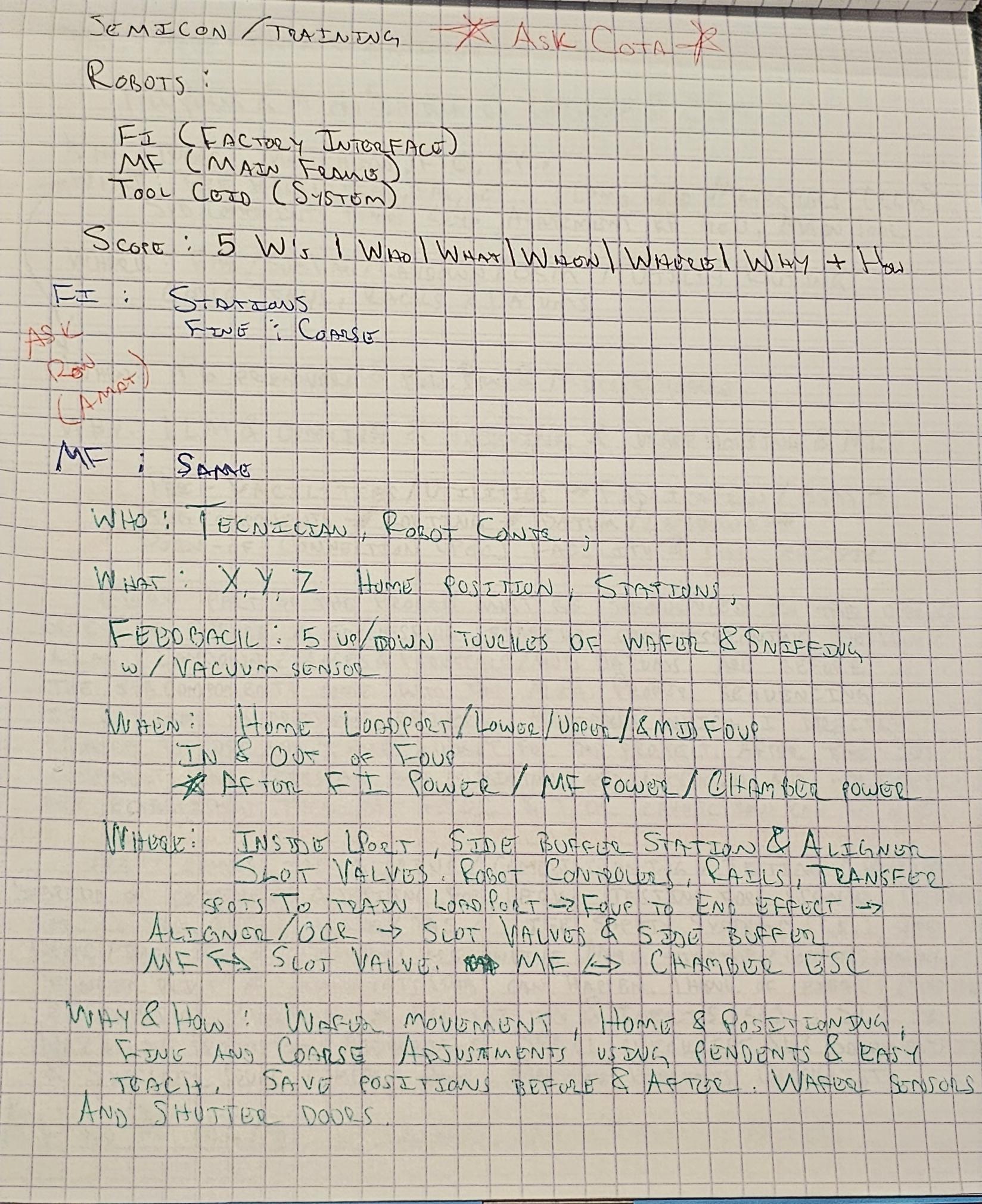
Subject Matter Technicians. The "Physics Engine for AI": field training, the 5W's framework, and real diagnostic habits, from coarse adjustments to fine X, Y, Z robot teaching.
View Products →Coming soon · Books & Community
Stay tuned for books and community updates for students, tradespeople and technicians aged 18+. Hands-on learning from the floor, in plain words.
Hear first: join the waitlist →// THE EXPERT'S EDGE
"Talk all you want about algorithms — if your model doesn't intuitively grasp what a slight pressure drop in a pneumatic line does to a robot's grip, you're building on sand."
Your broken parts teach AI repair. Domain expertise grounds models in operational reality — preventing physically nonsensical outputs or costly real-world mistakes. Real-world resilience in unpredictable environments? That's the unsung hero for mass-market humanoids.
P6 shows a perfect schedule: Design → Buy → Install → Qual. Clean lines. Seamless. Wrong. Physical constraints cause delays and failure every time. The Floor Reality Protocol maps the real sequence — what actually happens when a crate hits the dock.
// PHASE 1
Order Long Lead Materials before a wrench touches the floor. Ship coordination starts at design — not install.
// PHASE 2
Establish pedestals, base frames, and architectural datums in the fab/sub-fab. Workspace must be ready before tools arrive.
// PHASE 3
Route and stage critical support hardware: pumps, CRYO units, abatement systems, RF generators. Sequence before install.
// PHASE 4
The Facilities point of contact and the Tool point of contact are established ONLY after the sequence is validated. Acceptable and accurate — not assumed.
// PRODUCTS & TRAINING
Three ways to learn field logic from our team: a free PDF, a framework, and a live session. Paid items use secure checkout via Stripe.
Not sure where to start? Take a free quiz for your path → No signup; your answers stay in your browser.
Your first briefing. The tool move-in sequence, the words you will hear on the floor, and the 5W's for troubleshooting. No sign-up. Click and the PDF opens.
No email. No card.
Who, What, When, Where, Why, plus How. The diagnostic habit that turns "it's broken" into a clear pass-down, with a worked night-shift example.
🔒 Secure checkout via Stripe
A live 90-minute session with our team. Walk the Midnight Rocker Valve scenario from the first alarm to the root cause. Onboarding guide and tool install map included.
🔒 Secure checkout via Stripe
// FREE QUIZZES
Short self-checks with no signup. Your answers stay in your browser. They are not certifications, tests of competence or hiring qualifications.
New to semiconductor work? Find your foundational learning priorities and a starter path.
Evidence, troubleshooting and handoff habits, with a relevant next resource.
Transferable skills, terminology and transition priorities. No credential equivalence is claimed.
Team onboarding, ownership and process gaps, and one practical team priority.
Business and ramp capability priorities, and a useful next discovery question.
// CASE STUDIES & FIELD SKETCHES
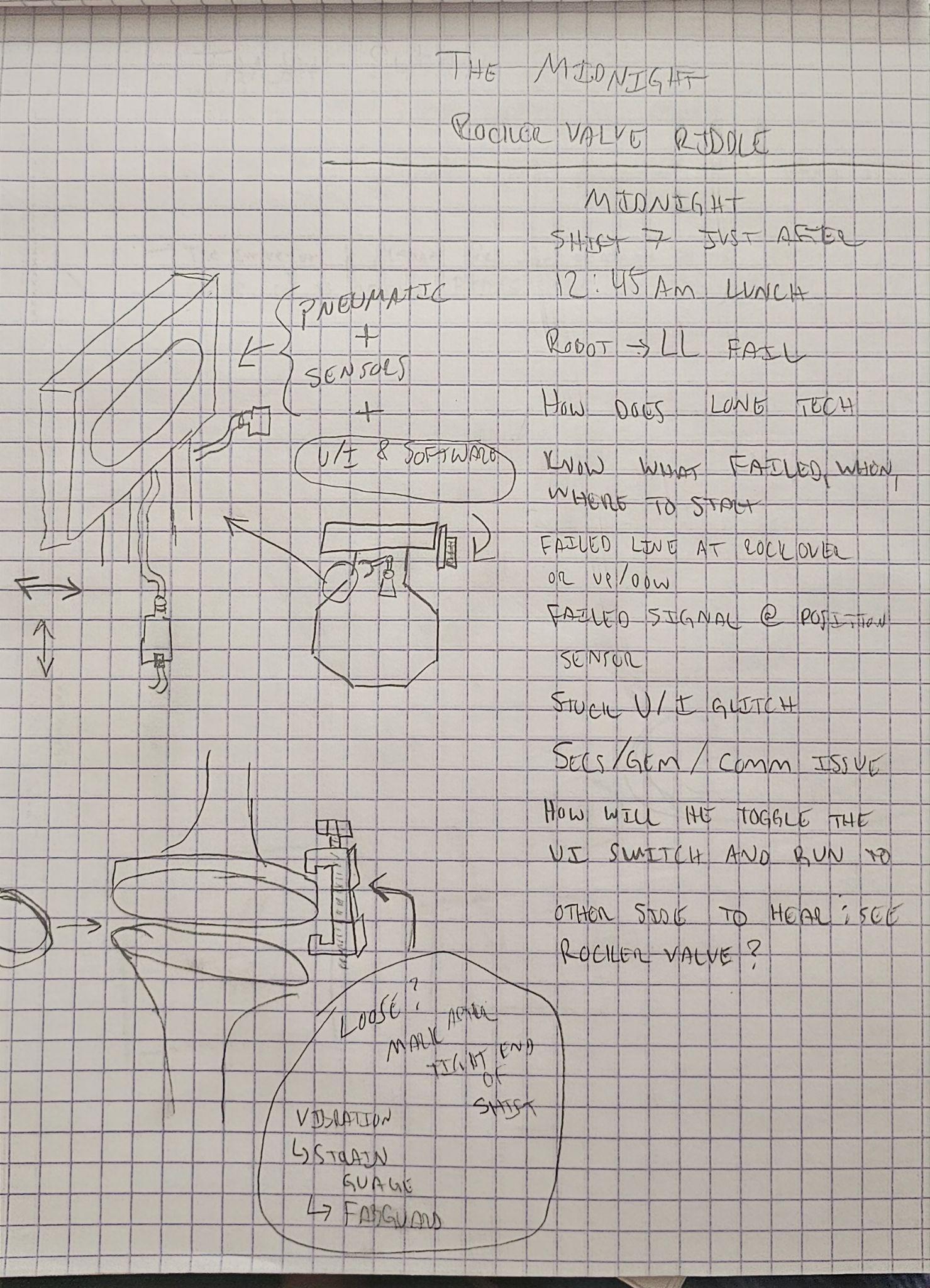
Hand-sketched on graph paper at midnight. These aren't textbook problems — they're field-reality diagnostics born from actual equipment failures.
// CASE-001
12:45 AM. Shift 7. One technician stands before a critical machine — its robot arm motionless inside the MainFrame octagon behind the Factory Interface. A system failure has struck. Is it a failed airline in the pneumatic rocker valve, a glitch in the position sensor, a frozen UI, or a comms issue? The critical UI switch is on the right. The problematic rocker valve is on the left. One tech. One chance. This is precisely the real-world scenario our story-based, choice-branch training prepares teams to conquer.
// CASE-002
Training technicians from foundational Coarse adjustments to precise Fine X,Y,Z teaching for perfect wafer and robot end-effector handoffs. 5 up/down wafer precision touches, FOUP & Robot Arm Sequence Training, Loadport transfers, Aligner/OCR positioning, side buffer stations, real-time feedback and automated QA pipelines. Empower your team to command these critical machines — transforming downtime into peak performance.
// CASE-003
Concept in development: QR tags on equipment linked to an n8n automation and QA pipeline, so a procedure can be captured, checked and replayed for training. The goal is a feedback loop that cuts rework and records training results at the tool.
// FROM THE FLOOR · COMING SOON
This space is for real words from real people who used 2-SMT training on the job. We only share what someone has agreed in writing to let us share.
Coming soon
What changed on their next shift after the Field Logic Masterclass.
Coming soon
How students, tradespeople and techs aged 18+ used the free Field Manual to get started.
Coming soon
What they see when their people use the 5W's on the floor.
Used the Field Manual, the 5W's or the masterclass on shift? Tell us how it went: support@2-smt.com
// AI-NATIVE · HOW WE BUILD
2-SMT is AI-native, born into an exciting and fast-changing semiconductor landscape. We build with VS Code, frontier models, open-source models, n8n and Blender, with humans in the loop who build and manage our systems. One agent builds, another checks, and nothing leaves the building without a human yes.
> outline the 5W's + 5 Senses lesson
1. Who is on the tool, and who was last
2. What changed since it last ran
3. When did the fault first show
4. Where: chamber, line, or facility
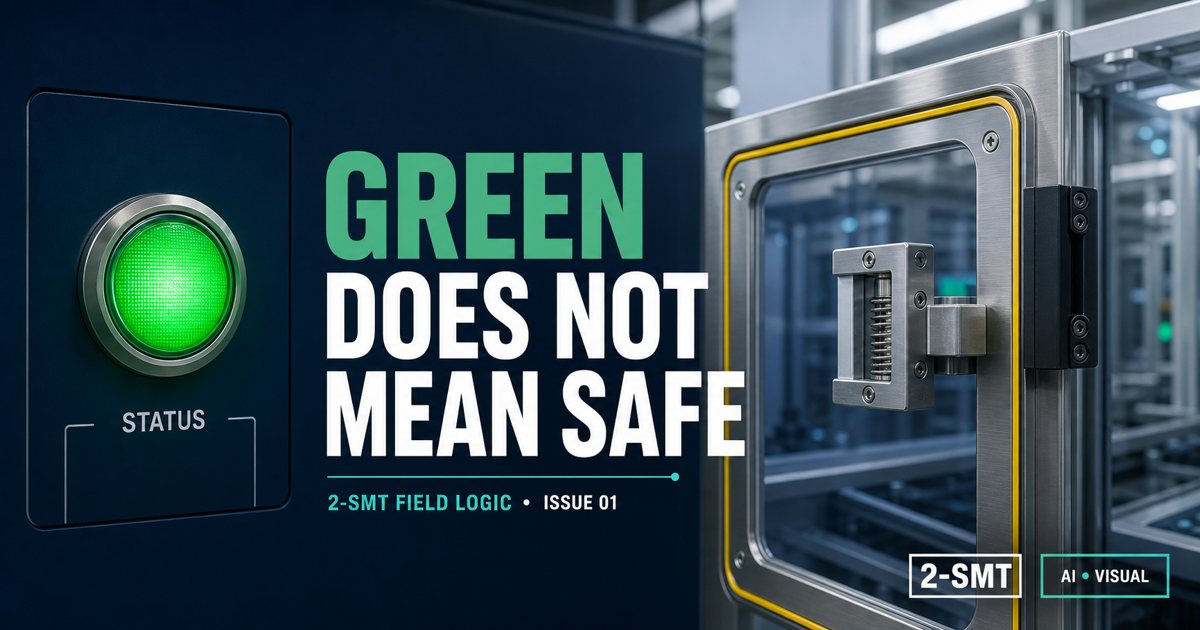
STOP: a green light is one witness
> review the outline against the brief
• Step 3 can be misread on night shift
• Add: second independent check
• Pass-down needs a time and a name
NEEDS A PERSON: lockout wording
verdict: revise, then approve
One-page handout
Title: Before You Open the Tool
Six questions, in order
Five senses, before the screen
Pass-down: what I saw / did / left
ready for review
Quiz · question 1 of 5
The status light is green. You may:
a) open the door
b) confirm with a second check ✓
c) restart the tool
5 questions drafted
Illustration of a 2-SMT working session. The agent output shown is representative, not a screen capture.
// 01 · THE BRIEF
The founder writes the outcome, the limits and what must not be touched. Agents work from that page, not from memory.
// 02 · BUILDER AGENT
Drafts the lesson, the page or the automation, and records every file it changes in a shared ledger.
// 03 · REVIEWER AGENT
Checks the builder's work independently, from the files themselves, and posts what it finds where both agents can read it.
// 04 · GATES AND A HUMAN YES
Automated checks run first. Then a person reads it. No send, no publish and no deploy happens without that approval.
The toolbox: VS Code, frontier and open-source models, n8n for workflow automation and Blender for 3D, with a person approving every release. We are AI-native. Concept work, not yet in production: QR-tagged procedures and 3D training visualisation.
// ILLUSTRATION · DRAWN MAP, REAL NOTE COUNTS
Illustration of our knowledge vault. Cluster sizes are the real note counts on 1 October 2026; the layout is drawn.
// ISSUE 01 · PUBLISHED 2 SEPTEMBER 2026 · 6 MINUTE READ
A status light is one witness. Real work needs two.
// CONTACT
Training, speaking or collaboration questions? Email our team.
support@2-smt.comFounder: Allyn Martinez
LinkedIn – Allyn MartinezOne short lesson from the fab floor at a time. Join the waitlist and we will send it to you. You can leave any time.
Join the waitlist →